 |
 |
 |
 |
 |
 |
 |
 |

Civic Celebrations
The civic parties
are celebrated in the cities and in almost all the towns. The most important
dates are: February 5 (the Constitution of 1917 is commemorated), March
21 (birthday of Benito Juárez), May 5 (anniversary of the Battle
of Puebla 1862), 15 and 16 of September (beginning of the independence
of Mexico), and November 20 (beginning of the Mexican Revolution).
The celebrations in citizens always participate in huge concentrations
are those of September. The 15, at eleven in the night, the President
of the Republic, the governors of the states and the municipal presidents
give the "Grito de Dolores" (Dolores' Scream) and they ring
a bell that symbolizes announcement in 1810 to start the the fight for
the independence of the country.
In Puebla, in the Peñon of Mexico City, in the surroundings of
Texcoco and in several towns people represent the 5th of May a simulation
of the famous battle against the French that it is prolonged until the
night and it comes to an end wiht the assault to the fortress.
Blessing of the animals & seeds
It is a rite that takes place in almost the whole country; the most usual date is January 17, day of San Antonio Abbot, protector of the animals. In Mexico City people, mainly the children, converge in the atrium of their parish taking their domestic animals, from canaries to dogs. In the Federal District the blessing is imparted in the afternoon: lambs, calves, bulls, horses, roosters, guajolotes the owners have adorned them with paper. In other regions like the valley of Toluca, the celebration is carried out the day of San Isidro Labrador. The yokes of oxen are always beautified with tapes or with flowers of red paper and the yokes sustain big mosaics made with all kinds of seeds.
In the
coasts they take place the most sumptuous carnivals. In several ports
of the Pacific, and others of the Gulf, also in the Peninsula of Yucatan,
with Campeche and Merida, where the carnival is still celebrated with
enthusiasm. Each town, even the smallest, organizes their parties: allegorical
cars, parade of processions, flowers, confetti and egg shells; traditional
dances and food everywhere.
The indigenous towns of the country celebrate carnivals different from
the accustomed ones. As all the ethnic parties in that the religious thing
mixes with the pagan thing, the carnival is at the same time amusement
and rite.
There are parts in that a puppet that symbolizes the carnival is burnt
and that means the beginning of the New Year; there are others in which
the meaning is to enter clean in a new season and to leave all the sludges
behind, the natives jump above a fire barrier made burning with hay.

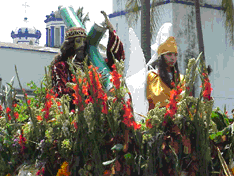
The Ceremonies
begin the Domingo de Ramos (Palm Sunday) with the sale, in front of the
churches, of crisscross palm leaves with fantasy and good taste. The important
rites are developed on Friday: images - richly adorned - carried by a
group of people, women with candels and flowers, and songs by all the
people that seize candles.
In the indigenous towns the acts are, frequently, a singular and touching
mixture of the beliefs of centuries ago and the current religion.
There is the burning of Judas or of Juan Carnival that has the meaning
to clean with the fire the past and to begin the New Year that begins
with the spring for any peasant, when the nature is renewed and they get
ready to sow.
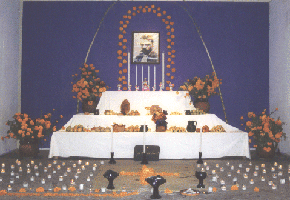
On November
the first the souls of the deceased children return to their houses ,
and the following day those of the adults; they can't miss none of them
food that they liked more in life. They are bought all class goodies,
fruit, chocolate, the atole and the appreciated dishes. In the domestic
altars they get ready with natural and paper flowers, the dishes and the
candles are placed, bread of dead, pictures, clothes. In many communities
people form a path of cempasúchil petals (flower of the dead),
from the street to the altar so the souls can find their way.
In the northwest of the State of Mexico and in Michoacan, besides offering
food, the families make objects of sugar with that represent the dear
objects or wanted by the deceased one: hats and boots, bulls and horses,
seats and furniture, and even cars and trucks.
Mainly in Mexico City, they model with sugar colored skulls in whose front
the names are written of who will eat them; for their varied sizes and
colors they end up being authentic pieces of art.

In almost
the whole country Our Señora de Guadalupe, the Virgin, is honored
on December 12, we she appeared on the hill of the Tepeyac, where the
mexicas worshipped Tonatzin, mother of the gods
In the capital of the Republic, the daily pilgrimages begin before one
month: the faithful ones meet with banners, magnificent floral offerings
and sometimes with dancers. In the Glorieta of Peralvillo it is where
the pilgrimage of several kilometers begins.
In many towns, big and small, young people get organized to complete one
anual promise to the virgin. They join money to travel on truck certain
distance, taking turns carrying a fire torch while running to their destination.
You can see men and women running by the highways of Mexico days before
December 12 to arrive to their destination.
This
novenary that precedes Christmas only takes place in Mexico and in some
Latin American nations; it seems that the evangelizing friars of the conquest
substituted a mexica celebration - in which they worshipped Huitzilopochtli
- for a Christian party with a new meaning.
It begins December 16 and it ends the night of the 24th with the birth
of Jesus. It is not always carried out in the same way, although in any
event the participants, be rural or people of the city, sing the litanies
as much in the churches as in the houses. The tunes and the wording change
depending on the region.
The Posadas more full with emotion are the ones of small villages. After
the accustomed prayers, a part of participants goes out in procession
with candles and flowers, taking in images of Mary and Joseph. When they
return, they find that they have closed the hall door of the church; they
request "Posada" (lodging) singing and from inside they are
refused. The hall door finally opens up and the Pilgrim Saints receive
lodging.
After requesting Posada, the piñata is hung in the atrium of the
church or the patio of a house: they are hanged with a rope; children
and adults take turns with a stick and blindfolded eyes try to hit to
the piñata and break it. When that is achieved the content of the
piñata sweets and season fruits flies around.
Charreadas, Bull & Roster Fighting
Ecoturismolatino
by principles opposes to this type of "Parties" - public shows,
but we cannot deny its existence and its popularity.
In the Mexico City as in the capitals of all the states, passionate people's
associations for the horsemanship, maintain alive the "Fiesta Charra";
this is practiced on open spaces in the countryside or in the squares
of rodeos. The rustic jaripeos also continues, especially in the north
of Mexico.
Very popular are also the Palenques where rooster fighting takes place;
in the towns that get permission so that the assisting people can bet,
alot of money is won and lost.
There
is not a town, even the smallest, where the funfair doesn't arrive: carrousels,
flying seats, revolvable platforms and joyrides.
Every funfair also goes accompanied by simple amusements as: the lottery,
tables with roulettes, shot to the target, carps of marionettes, labyrinths
of mirrors, fortune-tellers, circuses, etc.
Each party is also a market, where people acquire objects with a festival
content or as a souvenir. The Mexican markets are the most colorful in
the world; where they combine scents, colors, variety of goods and noises
between salespersons' screams and sale of cassettes or compact disks.
Fireworks, Toritos, Rockets & Gunpowder
Another
element of the Mexican parties is the fireworks. Those in charge of the
parties commend the work to some specialized artisans. In occasions these
coheteros (fireworkers) already arrive from their towns with the girándulas
(firework structures) made, other times they make them in the place; when
they are indigenous, the music accompanies during the whole time the work
of the coheteros.
The "Toritos" (bulls of lights), are made of wicker or of sticks
and covered with mat or with skin of an animal. A man places the frame
on his head and runs, while girándulas and rockets distributed
on the Torito explode.
Besides adding to the nights new and shooting stars to the sky, the rockets
also explode in the day, because it is the noise and the ascension what
counts. During the processions on daylight if the one in charge doesn't
light them, the rockets, with a cigarette a companion will go with him
taking an wood ember lighting the wick and making the rockets fly with
a buzz and an explosion at the end.
Among
the rites of the Ancient Mexico, dances were the most important. Many
of the movements and steps are from centuries; also the current attires
are transformations of the old ones.
The rite has not changed and it is still a pleasant sacrifice in honor
to the divinity. What is conserved of the attires of the past are the
deer skins and of other animals, the showy feathers, the rattles and the
buds of butterflies, and also the mirrors that before were refined stones.
Besides
the ritual dances that are carried out during the parties, Mexico is rich
in traditional dances, almost all are adaptations of old European dances.
The Jarabe Tapatío, known in the entire world as the national dance
of Mexico; the woman gets dressed as "china poblana" (type of
dress) and the man of charro, and both execute tap-danced movements.
The "jaranas", where the couples execute different tap-danced
steps that are alternated with softer steps. In the cities of Campeche
and Yucatan, the ladies dance adorned with their triplet of white artisela,
embroidery and adorned with fittings; in the towns the women dress with
the mestizo yucateca suit, of embroidered blanket.
The huapangos in Veracruz, Tamaulipas and the Huasteca potosina, have
intricate steps with which the women as the men impress the public. The
songs in falsetto, of origin huasteca, and the music of harps and requintos
give a very peculiar atmosphere.
We could also speak of more dances such as: the Sandunga, the Chiapanecas,
the Chilenas and the Canacua, all movements and color that accompany all
Mexican Party.