 |
 |
 |
 |
 |
 |
 |

Cusuco
Denomination:
National Park Country: Honduras
Located
in the Merendon Mountains south west of the industrial city of San Pedro
Sula, "Cusuco" was declared as a National Park in 1987 by the
Honduran parliament, it covers an area of 222.23km². The untouchable
core zone protects the highest and most endangered ecosystems which is
found from 1800 - to 2242 meters above sea level.
Shortly after the Second World War, a US lumber company exploted big parts of the lower Cusuco region. The main access road to Cusuco was built during this time. In 1959, the lumber activities stopped, and the whole area was declared as a forest reserve conserving the last remaining primary forests in the upper areas. Actually, the forest has recovered, the whole area presents an interesting mixture of primary and secondary forest. The National Park got his name from a typical Armadillo that is found in Central America, which is locally called Cusuco. The inhabitants of the region gave the area that name because some of the lumber compant trucks with their rain protection cover, looked similar to a Cusuco.
On
the lower parts of the mountains of Cusuco the vegetation consist of conifers
(pine forests) and tropical forest. Around 1500 meters the cloudforest
begins. Cloud forests are mountainous broad leaf forests found from 1500
meters to 2500 meters above sea level, depending on the local topography.
The clouds are the product of the high altitude and the resulting cooler
temperatures of the mountains, this builds a natural barrier for the hot
and humid Caribbean air that is forced to climb the mountains. It cools
down and condense. The result is clouds, constant fog and drizzle.
The vegetation has got adapted to these climatic and geographic conditions, for instance epiphytes. Epiphytes are able to take water and sometimes even nutritients from the air. Bromeliads (a typical family of the neotropics) and Orchids (the largest plant family in the world ) are examples for typical epiphytes. They shall not be confounded with parasitic plants. Epiphytes are not taking any nutritients or water from their host plants as parasites (for example the mistletoe) do; they are just using them as a seat. Lichens and mosses are completing the coverage of trunks and branches; it seems like there is no space in the cloud forest without plants, creating a mystic and dark atmosphere.
National Park is of outstanding importance for the surrounding communities and San Pedro Sula. Water is the reason. Cloud forests are water reservoirs. The vegetation collects the water from the air. When saturated, the water drips from trunks or leaf tips to the ground. The ground is spongy, protected by the vegetation from soil erosion, and is collected in lower and rocky parts of the grounds. This water reservoir is guarantying a constant water supply even in the dry season.
During
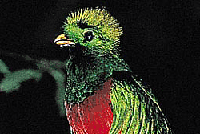
March till May, one of the typical early morning sounds of Cusuco Nationao
Park is the monotonous call of the Resplendent Quetzal (Pharomachrus mocinno),
the mystic and holy bird of the Aztecs and Mayas. Historic tails explain
the bright red breast of the male Quetzal as a symbol of the eternal life
of the Mayan warriors, who lost their battles against the Spaniards on
the battlefield. The Quetzal as a sign from the gods came down to the
warriors taking away and saving their souls. The legends of the Aztecs
are almost the same, saying that the red chest is the blood from their
last king Moctezuma, who died during the Spanish conquest. The habitat
of the Resplendent Quetzal is the cloud forest of Central America.

Other
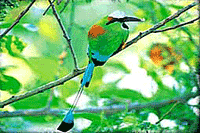
typical birds found in the cloud forests of Central America are the Green
Toucan (Aulacorhynchus praesinus), or the small Hilguero, which is detected
by his beautiful and typical song in the morning, it has inspired poets
and writers. A huge diversity of often strange and exotic insects and
evertebrates are the food of the many birds of the cloudforest. Trying
to survive, they evolved new and better forms to hide themselves from
the view of their raptors. At the end of the food chain are the huge Pumas,
Jaguars and Ocelots, they hunt for Coatis and Raccoons or Agoutis and
Peccaries. Huge tree ferns - some of up to 20 meters, the highest found
in all of Central America - they are typical for Cusuco and give the impression
as one is in a Jurassic park world.
Cusuco has a good maintained trail system. 4 trails start from the visitors center and offer walks ranging from 1km to 3 km. The visitors center offers basic overnight accomadation with use of bathroom facilities. The charm of Cusuco does not only come from the nature, but also because of the quit and harmonic life found in the 38 surrounding coffee towns. A visit to a coffee plantation completes the impressions that one takes home from this region.
This information
was provided by Dean Milverton and Mesoamerican
Travel, your best choice for EcoTouring Honduras.